Why Doesn’t “I’m Sorry” Always Fix the Hurt?
Updated: Sep 3
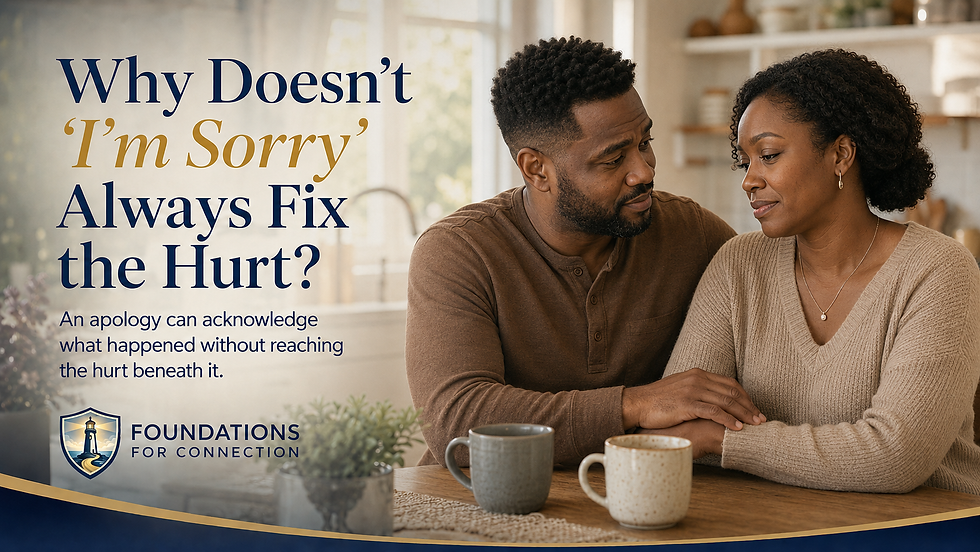
When Jenna walked into the kitchen, Michael was helping their daughter finish a school project at the table. Construction paper covered the surface, the glue stick had lost its lid, and their daughter was explaining why the model needed at least three more trees. Jenna placed two grocery bags on the counter and began putting the food away. She had spent the afternoon at an appointment with her mother, whose health had become increasingly unpredictable, and the news had not been encouraging. Michael had known about the appointment, but in the chaos of the evening, he had not yet asked how it went.
“Are you going to help with dinner?” Jenna asked.
Michael glanced at the clock. “I’m trying to finish this with Sophie. You could have just picked up something if you didn’t feel like cooking.”
The words were out before he considered how they might sound. He had meant that dinner did not need to become another burden for her. Jenna heard something entirely different. She had spent the day worrying about her mother, stopped for groceries on the way home, and walked into a house where several more things needed her attention. His comment sounded as though she had created the problem by failing to plan better.
“I didn’t say I don’t feel like cooking,” she replied. “I asked if you were going to help.”
Michael heard the sharpness in her voice and immediately realized that his comment had landed badly. “Okay, I’m sorry. That’s not what I meant.”
Jenna closed the refrigerator more forcefully than she intended. Michael turned back toward the school project, believing that he had corrected himself and that continuing the conversation would only make the evening more difficult. Jenna took out a cutting board and began preparing dinner. She was not trying to punish him by becoming quiet. She simply did not trust herself to explain why the remark had hurt without either crying or starting an argument in front of their daughter.
They moved through the rest of the evening politely. Michael cleared the dishes while Jenna helped Sophie get ready for bed. Later, when they sat down in the living room, Michael reached for Jenna’s hand. She let him hold it, but he could feel that something remained unsettled between them.
“Are you still upset about what I said?” he asked.
“A little.”
“I apologized.”
“I know.”
Michael waited, expecting her to say more. When she did not, frustration began replacing his concern. He had recognized that his comment was unhelpful, apologized almost immediately, and taken care of the dishes afterward. He was no longer sure what Jenna expected from him.
“I don’t know what else you want me to do,” he said. “I said I was sorry.”
Jenna pulled her hand away. “Never mind.”
Michael leaned back against the couch. He felt as though his apology had been rejected and the rules had changed without anyone telling him. If saying the wrong thing was a problem and apologizing did not resolve it, he wondered what possible response would have been enough. Jenna experienced the same moment very differently. She was not refusing to accept his apology. She was trying to understand why she still felt alone after receiving it.
The comment in the kitchen had hurt because it touched something much larger than dinner. Jenna had been carrying worry about her mother for weeks while trying to keep work, parenting, and the household moving. She did not need Michael to prepare the perfect meal or remove every responsibility from her evening. She needed some indication that he saw how much she was carrying. When he told her she could have picked something up, she heard confirmation of the fear already growing inside her: that she was alone with responsibilities that were becoming too heavy.
Michael did not know that this was what his words had reached. He believed the problem was the sentence itself, so he apologized for saying it. Jenna was hurting because of what the sentence seemed to say about her place in their relationship. His apology acknowledged that his wording had been poor, but it did not reach the meaning the moment had taken on for her.
The next morning, Jenna remained quieter than usual. Michael made coffee and began emptying the dishwasher, hoping that being helpful would ease the tension between them. When she did not brighten, he became discouraged. He began to feel that she was holding the mistake over him, while she began to believe that he wanted her to stop hurting so that he could stop feeling uncomfortable.
This is where apologies often become confusing for couples. The person who caused the hurt may sincerely regret what happened and believe that saying sorry communicates that regret. When the other person remains upset, it can seem as though the apology has been ignored, dismissed, or judged inadequate. The hurt partner may appreciate the apology while still feeling that the most painful part of the experience has not been understood.
Later that day, Michael asked Jenna about her mother’s appointment. She told him that the doctor wanted to run more tests and that she was frightened by how quickly things seemed to be changing. As she spoke, Michael began to see the previous evening differently. He had been focused on finishing the school project and organizing dinner. He had not noticed that Jenna had arrived home carrying something much heavier than the grocery bags.
“I didn’t ask you how the appointment went,” he said.
“No,” Jenna replied. “You didn’t.”
Michael felt the urge to explain how distracted he had been, but this time he stopped. The forgotten question, the comment about dinner, and Jenna’s distance afterward were no longer separate events. He could see why his quick apology had not reached her. He had regretted the words without yet understanding the hurt surrounding them.
Jenna had not needed a longer or more dramatic apology. She had needed to know that Michael understood why the moment mattered. Michael had believed they were discussing an unfortunate comment about dinner. Jenna had been trying to tell him what it felt like to come home afraid and overwhelmed and not feel seen by the person she most wanted beside her.
An apology can acknowledge that something went wrong without repairing what happened between two people. It may be completely sincere and still leave part of the hurt untouched. The words “I’m sorry” matter, but they cannot automatically communicate an understanding that has not yet been reached.
For Jenna and Michael, recognizing this difference changed the conversation, but it did not answer every question about repair. Jenna still needed to express hurt without Michael feeling that nothing he did would ever be enough. Michael needed to stay present long enough to understand an experience that had looked very different from his side. They were beginning to discover that repair involved more than determining who was wrong and whether an apology had been offered.
A Question to Consider
When an apology does not seem to settle the hurt in your relationship, what might still be missing? Is one of you waiting for the subject to be over while the other is still waiting to feel understood?
About Foundations for Connection
Foundations for Connection provides accessible relationship education to help people understand themselves, their partners, and the patterns shaping their connection. Our practical, evidence-informed courses explore emotional needs, relationship patterns, repair, and emotional safety.
This article was written by Trish Morris, creator of the How Relationships Work course series. If you would like to explore this topic through self-guided learning, you can view the individual courses, the complete six-course series, or begin with the complimentary Relationship Health Assessment.
If your relationship needs more personalized support, Trish also works with couples through HELPPS Psychotherapy Services, providing online couples psychotherapy to people across Ontario.


