Why We Become Defensive & What It Costs Us
Updated: Sep 1
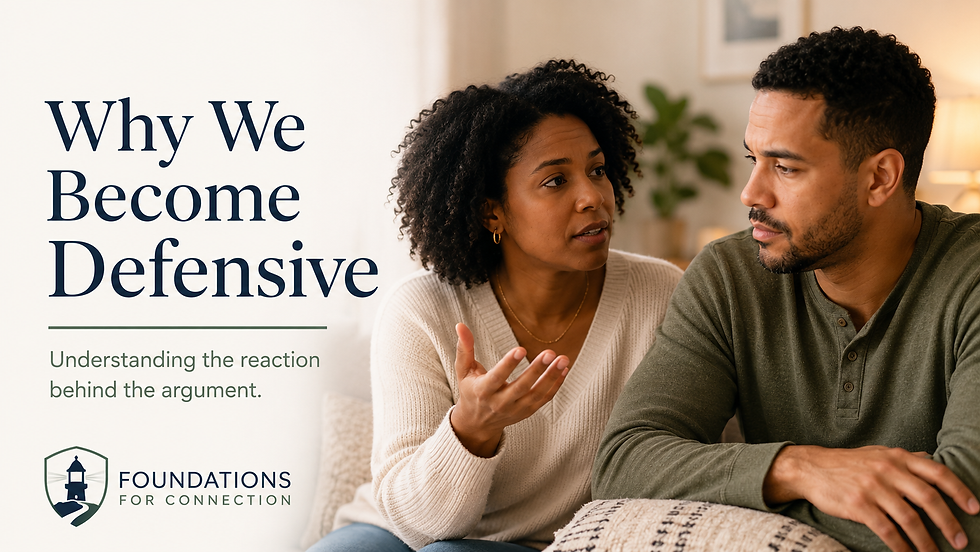
No one wakes up planning to be defensive.
One Saturday morning, Matt wakes up feeling pretty good about life. The weather is nice, he's had a decent week at work, and nothing major is wrong. He grabs a coffee and starts moving through his morning. As he's leaving the bedroom, his wife, Julie, notices the pile of clothes beside the bed and says, "Could you put those in the hamper when you get a chance?" He tosses them in the hamper and heads downstairs without giving it much thought.
A little later they're eating breakfast together when she mentions that he never replied to a text message she sent the day before. She had been trying to make plans for the weekend and eventually just made the decision herself because she didn't hear back. He explains that work was busy and he forgot. Again, it doesn't seem like a particularly big deal.
Later that morning they're getting ready to leave the house. As they're walking out the door she says, "Can you make sure the back door is locked before we go? You forgot yesterday."
Individually, none of these comments seem especially significant. In fact, she may be completely reasonable in bringing each one up. But something is happening inside him. The comments are beginning to collect.
What started as a reminder about clothes becomes a reminder about a text message, and then a reminder about the door. Without realizing it, he stops experiencing them as separate conversations and starts experiencing them as one larger message. By lunchtime, he no longer feels like he's hearing comments about clothes, text messages, and door locks. Instead, he feels like he's hearing that he's careless, forgetful, not paying enough attention, and not doing a good enough job.
Whether his wife intended those messages is almost beside the point. Those are the meanings he has started attaching to what he's hearing, and those meanings shape how he responds.
So when another concern comes up later in the day, something changes. Instead of simply hearing the concern, he begins defending himself. He explains why he forgot. He points out the things he did remember. He reminds her of everything he has been carrying lately. Without consciously deciding to do so, he starts building a case for why he isn't the person he suddenly feels accused of being.
Most people recognize some version of this experience because defensiveness rarely begins with a desire to avoid responsibility. More often, it begins with the uncomfortable feeling that who we are is being questioned.
No one enjoys feeling inadequate. No one enjoys feeling like they've disappointed someone they love. When those feelings begin to surface, our natural instinct is often to protect ourselves. The difficulty is that what feels protective to us can feel dismissive to the person sitting across from us.
His wife may have been trying to communicate something fairly simple. Maybe she wanted more partnership. Maybe she wanted greater reliability. Maybe she simply wanted him to understand her frustration. Instead, she now finds herself listening to explanations.
From his perspective, he's trying to help her understand his side of things. From her perspective, he isn't hearing hers. And it spirals into an argument.
This is one of the reasons defensiveness creates so much trouble in relationships. The conversation quietly shifts away from understanding and toward self-protection. One person wants their hurt understood, while the other wants their intentions understood. Both are reaching for something important, yet both often leave the conversation feeling unheard, unloved, and disrespected.
What makes defensiveness especially difficult is that it often comes from a good place. Most people are not trying to be dismissive, and most people are not trying to avoid accountability. They are trying to protect themselves from feeling criticized, blamed, inadequate, or misunderstood. The problem is that self-protection often gets in the way of connection.
When someone brings us a concern, they are usually hoping we will be curious about their experience. They want to know that what they are feeling matters to us. When we immediately move into explanation mode, they often experience it as a lack of care, even when care is actually present.
Over time, this can become a painful pattern. One person brings a concern, the other becomes defensive, the first person feels unheard and pushes harder, and the second person feels more criticized and defends themselves more strongly. Before long, both people are frustrated, and neither one feels understood.
The good news is that defensiveness is not a character flaw. It is a human response. Once we begin recognizing it, we can start paying attention to what is happening underneath it. Instead of focusing only on the argument itself, we can become curious about the deeper experience driving our reaction.
What am I feeling accused of? What am I trying to protect? What would happen if I listened a little longer before explaining myself?
Questions like these create room for something different to happen. They slow the conversation down just enough for understanding to enter the room. And often, that small amount of space is where meaningful connection begins.
In our next article, Why We Keep Having the Same Argument, we'll explore why some disagreements seem to happen over and over again, even when both people are exhausted by them. We'll look at what keeps these conflicts going and why solving the surface issue often isn't enough.
Reflective Question
Think about a recent disagreement in your relationship.
When you felt the urge to defend yourself, what was it that felt threatened?
Were you trying to protect yourself from feeling criticized? Misunderstood? Inadequate? Unappreciated?
Sometimes defensiveness tells us less about the argument itself and more about the fears or insecurities that were activated beneath it.
Understanding what we are trying to protect is often the first step toward responding differently.
About Foundations for Connection
Foundations for Connection provides accessible relationship education to help people understand themselves, their partners, and the patterns shaping their connection. Our practical, evidence-informed courses explore emotional needs, relationship patterns, repair, and emotional safety.
This article was written by Trish Morris, creator of the How Relationships Work course series. If you would like to explore this topic through self-guided learning, you can view the individual courses, the complete six-course series, or begin with the complimentary Relationship Health Assessment.
If your relationship needs more personalized support, Trish also works with couples through HELPPS Psychotherapy Services, providing online couples psychotherapy to people across Ontario.


